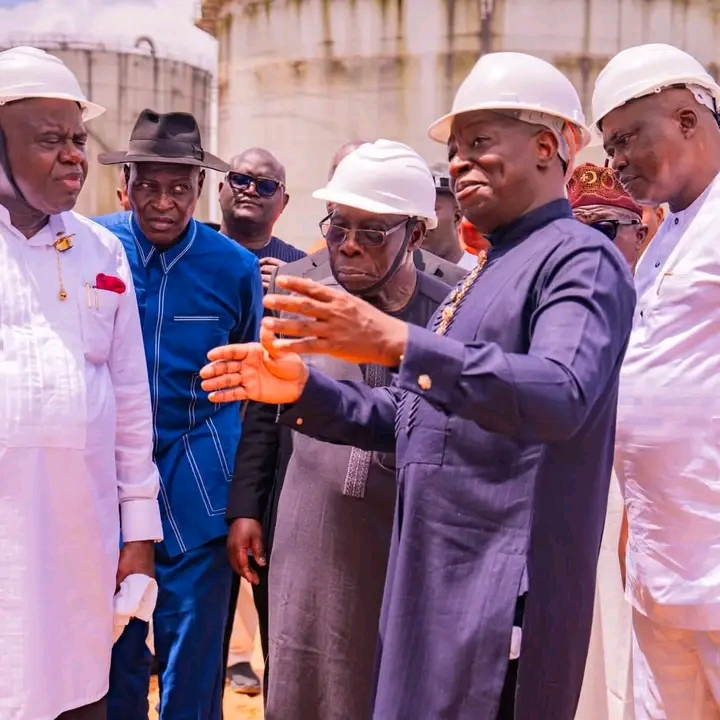
Former President Olusegun Obasanjo and Bayelsa State Governor Douye Diri have called for an increase in the 13 per cent derivation revenue allocated to oil-producing states, insisting that the current arrangement does not adequately compensate the region for its contribution to Nigeria’s economy.
They made the call on Monday during the inauguration of the Crude Distillation Unit (CDU) of Azikel Refinery at Obunagha, Yenagoa Local Government Area of Bayelsa State.
Obasanjo, who commended the state government for supporting the refinery project, said oil-producing states and communities had yet to receive a fair share of the benefits from the resources extracted from their territories.
“You are right that the states and oil-producing communities have not got a fair deal so far. Thirteen per cent is the beginning,” the former president said.
He urged stakeholders in the Niger Delta to sustain their demand for a better deal, while commending Diri for effectively utilising the state’s revenue to execute development projects.
Obasanjo also challenged the President of Azikel Group, Dr Azibapu Eruani, to ensure that the refinery was completed within the next 12 months, expressing confidence that its production capacity could subsequently be doubled.
The former president, who said he would officially turn 90 next March, recalled that he had laid the foundation of the project eight years ago and expressed satisfaction with the progress made since his previous visit.
He commended Eruani, the refinery’s technical and engineering team, the African Finance Corporation (AFC) and the African Export-Import Bank (Afreximbank) for their contributions to the project.
The $1 billion refinery, owned by Azikel Petroleum under the Azikel Group, is expected to produce 2.5 million litres of petrol and two million litres of diesel daily, alongside other petroleum products.
Earlier, Eruani described the installation of the CDU as a major milestone towards completing the refinery, expressing optimism that the project would accelerate industrialization in Bayelsa and the wider Niger Delta.
He said the refinery was conceived to enable the region to participate more actively in the petroleum industry rather than remain merely a source of crude oil for processing elsewhere.
Eruani also commended President Bola Tinubu for supporting indigenous refining initiatives, noting that local refining was consistent with the Federal Government’s objective of improving the availability and affordability of petroleum products.
In his remarks, Diri said the refinery vindicated the long-standing agitation by Niger Delta communities for greater participation in the petroleum industry and a fair share of the benefits derived from their natural resources.
The governor criticised the Land Use Act and the existing derivation formula, arguing that the legal and revenue-sharing arrangements disadvantaged oil-producing states.
“The Land Use Act is unfair. Surface resources belong to states, but what lies underneath belongs to the Federal Government. That law is obnoxious and not good for any just society,” Diri said.
He maintained that the region was not seeking to appropriate all the benefits from oil resources but wanted to be an active partner in decisions concerning their exploration, management and utilisation.
“We do not want to take it all to ourselves. We just want to be co-players in determining how it is done. Thirteen per cent is not enough for the states,” he added.
Diri expressed optimism that the refinery would create opportunities for Bayelsa residents to participate more directly in the petroleum value chain, urging them to acquire the skills required to benefit from the anticipated employment and industrial opportunities.
He also called on African countries to process their natural resources locally to retain more economic value, generate jobs and promote industrial development.
The governor urged oil companies operating in the Gbarain/Obunagha area to support the project by rehabilitating the road leading to the refinery, complementing the state government’s efforts to improve infrastructure.
The calls for increased derivation revenue came against the backdrop of renewed demands in the Niger Delta for greater resource control, economic participation and a more equitable distribution of the benefits of petroleum production.
About The Author