For Hon Munachim Alozie, empowering women goes beyond making promises. It involves providing practical opportunities and support that can improve their livelihoods and strengthen their families.

Recognising the important role women play in the economic and social wellbeing of their families and communities, Hon Munachim Alozie has consistently sought ways to support women across the Obingwa-Ugwunagbo-Osisioma Federal Constituency.
As part of his empowerment initiatives, he has ensured that women are included in various training programmes designed to equip them with practical skills that can enable them to become self-employed and economically independent. Through such programmes, beneficiaries are exposed to opportunities that can help them establish small businesses and improve their household incomes.
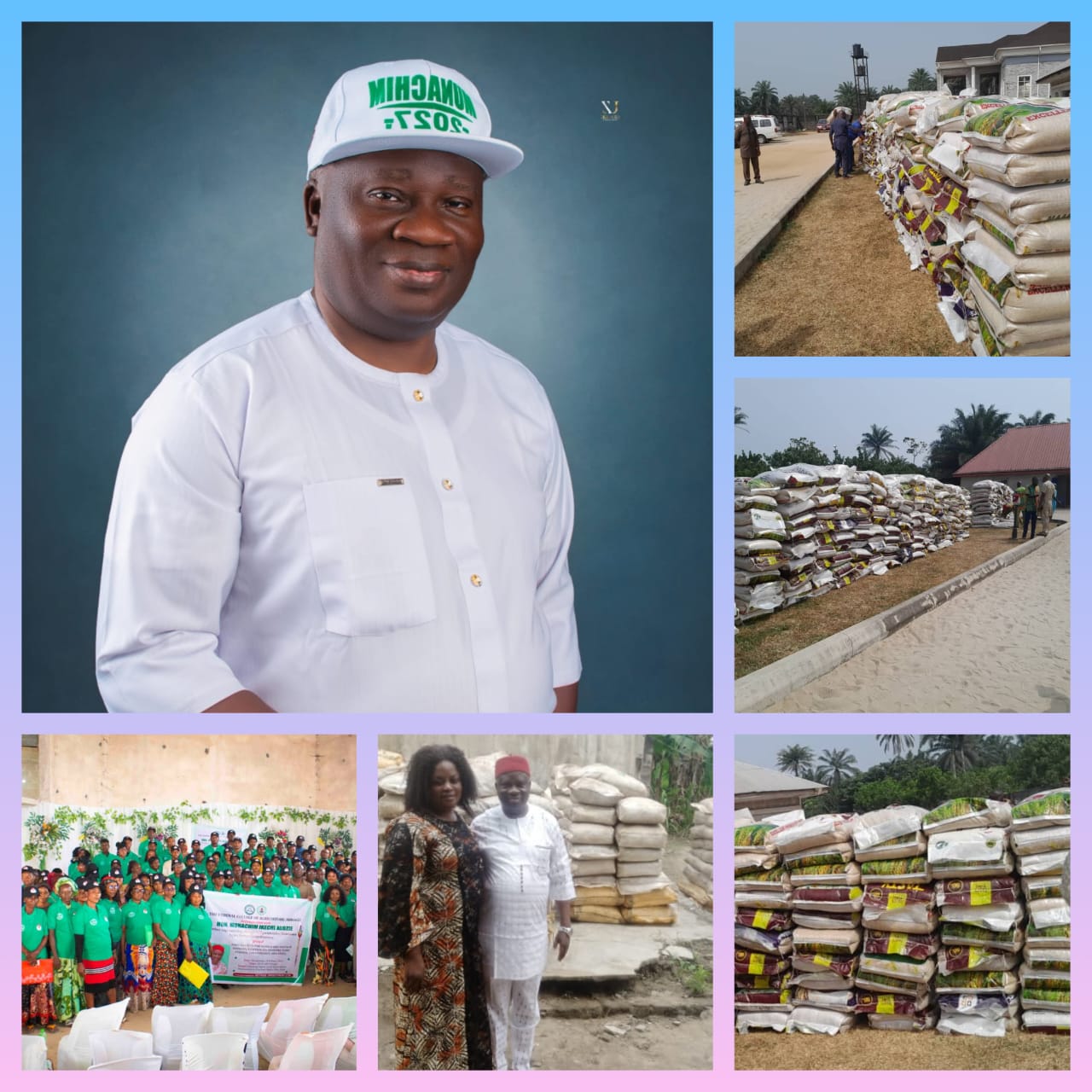
He has also supported women involved in agriculture by providing them with 1600 bags of fertiliser to enhance their farming activities and improve food production. The gesture reflects his understanding that many women depend on farming and related activities for their livelihood.
Beyond training and agricultural support, Hon Munachim Alozie has also responded to the immediate welfare needs of women, particularly at a time when rising food prices placed considerable pressure on low-income families.
Following the removal of the fuel subsidy and the consequent increase in the prices of food and other essential commodities, he distributed 1600 bags of rice and other food items to women across the 31 wards of the Constituency, irrespective of their political affiliations.
Three trailer loads of rice and other food items were distributed at various times to women leaders representing the Labour Party, APC, APGA and PDP across the 31 wards. Cash gifts also accompanied the food items as additional support.
The gesture was deliberately extended across party lines. For Hon Munachim Alozie, representation should embrace everyone, regardless of political affiliation. His concern is not limited to those who supported him politically; it extends to the wider community and, particularly, families facing economic hardship.
Although he does not regard the distribution of relief materials to constituents as an intervention that necessarily needs to be publicised, the gesture demonstrates his concern for vulnerable families and his commitment to supporting his constituents in practical ways.
His approach to women’s welfare, therefore, combines empowerment, agricultural support and immediate social relief: training women to acquire skills, providing fertilisers to support their farming activities, and offering food assistance when economic circumstances make household survival more difficult.
At a time when many families were struggling with rising food costs, Hon Munachim Alozie chose to respond not only with words, but with practical assistance.
For him, supporting women is ultimately about strengthening families and building more resilient communities. And in extending these interventions across party lines, he demonstrates his belief that the welfare of the people should come before partisan considerations.
As he prepares himself for his reelection, he has reaffirmd his commitment to making the welfare of women a top priority.
About The Author