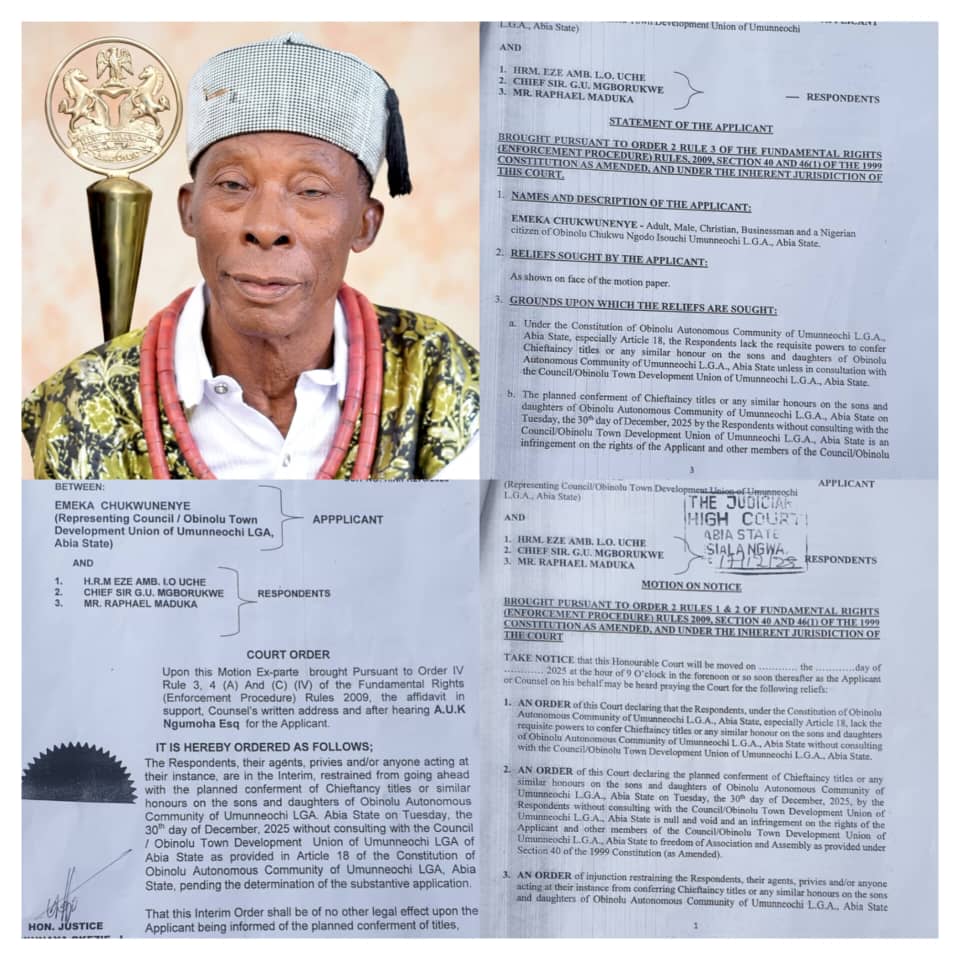
Fresh controversy has erupted in Obinolu Autonomous Community in Umunneochi Local Government Area of Abia State following allegations that the traditional ruler, HRM Eze Amb. L.O. Uche, went ahead with the conferment of chieftaincy titles despite a subsisting interim order issued by the High Court of Abia State restraining such action.

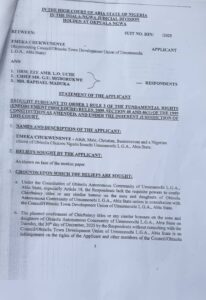
The legal dispute, which has continued to generate tension within and outside the community, stemmed from Suit No. HIN/FR276/2025 filed before the High Court sitting in Okpuala Ngwa by Emeka Chukwunenye, representing the Council and Obinolu Town Development Union (OTDU) of Umunneochi L.G.A.
The suit challenged the authority of the traditional ruler and other respondents to independently confer chieftaincy titles on sons and daughters of the community without consultation with the Obinolu Town Development Union, as allegedly required under the community’s constitution.
Named as respondents in the matter are HRM Eze Amb. L.O. Uche, Chief Sir G.U. Mgborukwe, and Mr. Raphael Maduka.
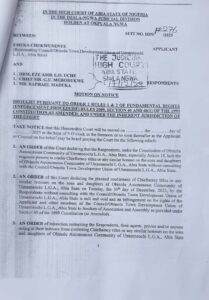
Court documents revealed that the applicant sought declarations and injunctions restraining the respondents from proceeding with the planned conferment of titles scheduled for December 30, 2025, arguing that the action violated Article 18 of the Constitution of Obinolu Autonomous Community and infringed on the rights of members of the union to freedom of association and assembly as guaranteed under Section 40 of the 1999 Constitution of the Federal Republic of Nigeria.
In an interim order delivered on Wednesday, December 17, 2025, Hon. Justice Enyinnaya Okezie restrained the respondents, their agents, privies, and anyone acting on their behalf from proceeding with the planned conferment of chieftaincy titles pending the determination of the substantive application before the court.
The court specifically ordered that no chieftaincy titles or similar honours should be conferred on members of the community without consultation with the Council and Obinolu Town Development Union as provided under the community constitution.
However, despite the subsisting court order, reports from the community alleged that HRM Eze Amb. L.O. Uche went ahead with the conferment ceremony, a move that has sparked outrage among some stakeholders and deepened divisions within Obinolu community.
Sources within the community further alleged that HRM Uche has over time developed a reputation for disregarding court directives and acting in defiance of legal processes, an allegation that has continued to fuel criticism and controversy surrounding his leadership style.
The crisis has also drawn attention to several provisions contained in the constitution of Obinolu Autonomous Community regarding the powers, conduct, and responsibilities of the Eze.
Under Article 9 of the constitution, the Eze is expected to conduct himself in a dignified manner, remain above corruption, and preserve the sanctity of the traditional institution. Article 10 further states that the Eze shall serve as custodian of the customs and traditions of the community while promoting peace and stability.
The constitution equally establishes the Council of Ichies and Chiefs, known as Nnakaeze in Council, as an advisory and executive body expected to work alongside the Eze on major community decisions.
Court filings by the applicant argued that the powers of the traditional ruler were not absolute and must be exercised in consultation with the Obinolu Town Development Union and relevant community structures.
The applicant maintained that bypassing the union in the conferment process amounted to a circumvention of the constitution guiding the autonomous community.
Legal documents presented before the court further emphasized that associations and unions are governed by their constitutions and that no individual or authority should act outside those constitutional provisions.
The matter has continued to attract reactions from indigenes and observers, with many expressing concern over the growing leadership crisis and its implications for peace, unity, and traditional governance in the community.

As the substantive suit remains pending before the court, attention is now focused on the next legal proceedings and the possible implications of the alleged disobedience to the interim order issued by the High Court.
About The Author